16.4.12

Ai Weiwei: "The Internet is uncontrollable, freedom will win" | TheNextWeb

It’s easy to forget that Ai Weiwei is an artist, at times. The man who is so often (and rightly) described as ‘outspoken’ and a ‘dissident’ is one of the most vocal critics of the Chinese regime, particularly on the subject of Internet censorship, to the point that it tends to overshadow his work.

Ai, who famously designed the Beijing ‘Birds Nest’ Olympic stadium, something he now regrets, discusses the Chinese government and its attitude to technology and the Web in a new op-ed published by The Guardian.

In the article, that is also available in Chinese, Ai looks at the affect that the Great Firewall censorship has had on China. An avid user of Twitter — @awiwi – he pens an argument that, in the long term, China’s can’t keep the power of the Internet at bay forever.

The government is certainly doing its best to provide that theory wrong. Its heightened efforts to quash ‘harmful information online’ have seen it implement a identification verification policy for microblogs (albeit loosely so far) and make arrests, close websites and restrict Twitter-like services following excessive political speculation last month.

“[China] blocks major internet platforms – such as Twitter and Facebook – because it is afraid of free discussion,” Ai says. “And it deletes information. The government computer has one button: delete.”

Ai compares China’s Web effort to the construction of a dam:

China may seem quite successful in its controls, but it has only raised the water level. It’s like building a dam: it thinks there is more water so it will build it higher. But every drop of water is still in there. It doesn’t understand how to let the pressure out. It builds up a way to maintain control and push the problem to the next generation.

Ultimately, he believes, this approach will see the Internet and freedom “win” in the communist country:

It still hasn’t come to the moment that [the regime] will collapse. That makes a lot of other states admire its technology and methods. But in the long run, its leaders must understand it’s not possible for them to control the internet unless they shut it off – and they can’t live with the consequences of that. The internet is uncontrollable. And if the internet is uncontrollable, freedom will win. It’s as simple as that.

The over-arching effect of China’s Internet freedom, Ai says, impacts on more than just civil liberties, it also blocks creativity, leaving China “far behind” other nations, he says.

For example, while those in the US discuss the (unlikely) possibility that Apple might bring its operation and manufacturing plants to the US, China’s dream is for the design of the device, and others like it, to come from within the Asian country.

Ai believes that the flagship Apple smartphone is  ”an understanding of human nature” and therefore it cannot be conceived from within China, he argues:

If a person has never had the right to choose their information, freely associate with any kind of ideology, and develop an individual character with some passion and imagination – how can they become creative?

Ai is unique in not being afraid to criticise, and be seen criticising, China. Consequently, his vocal comments have seen him handed a series of stiff punishments from authorities.

At its worst, he was detained for 81 days last year after a series of comments, released after apparently confessing his crimes. Though initially forbidden to return to social media, Ai quickly returned to his regular diet of Twitter and its Chinese equivalent Sina Weibo.

Last year he was hit by a massive $2 million tax bill but his supports used social media to rally round and collect donations to help pay it.

His latest scuffle with authorities saw the state order him to switch off a series of surveillance cameras that the artist had set up across his home. Ai had made the feed freely available online from April 2 to mark a year since his detention.

It remains to be seen how his latest article will be received by authorities in China and whether there will be further punishment dealt out to Ai Weiwei for his criticisms.

The full opinion article is most definitely worth reading, you can find it here.

Very interesting perspective on the current state and future of Internet freedom in China.

28.3.12

China: the next must-have, private jets | beyondbrics | News and views on emerging markets from the Financial Times – FT.com

It will come as no surprise that rich Chinese have developed a taste these days for private jets. It is a short step, in China, from Gucci to Gulfstream: according to a survey of China’s richest people, released by the Hurun report at the Asian Business Aviation Conference Asian Business Aviation Conference in Shanghai, 13 per cent of Chinese with personal assets over Rmb100m plan to buy a corporate jet.

China had only 32 business jets registered in 2008, but that number rose to 132 by last year, according to state-owned China Daily. Beijing’s latest five year plan calls for developing the industry, and Cessna, one of the world’s biggest makers of business jets, recently signed agreements with Chinese partners to build business jets in Chengdu. The aviation industry is salivating at the opportunities presented by the notion of rich Chinese looking for the convenience – not to mention that sheer bragging value – of owning one’s own personal airplane.

But VistaJet, the ultra-luxurious Swiss business aviation company, is confident that there will be plenty of rich Chinese who think owning a jet is just too much trouble. VistaJet promises on-demand access to the company’s 31 near-new Bombardier aircraft, under a subscription model which VistaJet says makes much better financial sense than owning a jet for anyone who flies less than 500 hours per year. VistaJet today announced a memorandum of understanding with Beijing Airlines (the private jet subsidiary of Air China) that will allow it to base some of those aircraft in China, and eventually fly between domestic Chinese destinations.

Thomas Flohr, VistaJet chairman and founder, knows that deciding to buy a jet, especially in China, is not always a purely rational decision. Reason not the need: ultra high net worth Chinese have given “need” an all new meaning. But he is sure there will still be plenty of value-conscious business people around – even in China – who want access to a jet without having to pay for pilots, mechanics and downtime.

Flohr said his company is already doing good business flying the Chinese to Africa and Africans to China – often to remote locations that could not conveniently be reached by commercial airlines. “As an entrepreneur, you cannot afford to spend up to three days flying commercially between Harbin and Khartoum,” he said, adding “nor are you going to want to fly on some of the airlines that will get you there”. And even if some Chinese entrepreneurs are tempted to buy a jet rather than a block of hours on VistaJet, there will still be plenty of wives and kids, grandmas and grandpas of entrepreneurs who need moving from place to place – and as Flohr put it, first class on Air China will no longer cut it once they have tasted private aviation.

Related reading:
Chinese airlines hit by dispute over hedging, FT
China creates turbulence over EU aviation levies, FT
Luxury brand makes links with China’s past, FT

Not surprised the Chinese have taken to private planes.

15.3.12

Wen Jiabao attacks party conservatives on the way out the door | via @FinancialTimes

(Source: FT.com)

Premier Wen Jiabao©Getty

Chinese premier Wen Jiabao fired a parting shot at conservative officials in the ruling Communist party, warning them that China could face another Cultural Revolution unless it undertakes urgent political reforms.


“Without successful political structural reform, it is impossible for us to fully institute economic structural reform and the gains we have made in this area may be lost,” Mr Wen said at his farewell briefing at the National People’s Congress, China’s rubber stamp parliament which meets for just 10 days every year.


More

ON THIS STORY

ON THIS TOPIC

IN CHINA

“New problems that have cropped up in Chinese society will not be fundamentally resolved and such a historical tragedy as the Cultural Revolution may happen again,” the premier added, in remarks that were broadcast live on national television. “The mistake of the Cultural Revolution and impact of feudalism are yet to be fully eliminated.”


Mr Wen, who will step down from the party’s powerful politburo standing committee later this year, directed his aim at rivals including Bo Xilai.

Mr Bo is the ruling party official in Chongqing, a large city in southwest China, and a candidate for promotion to the top ranks of the party in the upcoming leadership transition. His propects, however, have been damaged by a recent scandal involving Chongqing’s former police chief.


Mr Wen’s references to the anarchy of the 1966-76 Cultural Revolution, during which millions of people were persecuted and perished, appeared to be a swipe at the “Cultural Revolution-style” campaigns organised by Mr Bo in Chongqing. The campaigns evoke revolutionary, or “red”, propaganda and ostensibly target organised crime.


In another rare example of open criticism among senior Communist party officials, Mr Wen also addressed the scandal that brought down Mr Bo’s former police chief and political ally, Wang Lijun, who tried to defect to the US last month. Mr Wang is in custody and his case is under investigation.

“The current [Chongqing] party committee and government of Chongqing must seriously reflect on the Wang Lijun incident and learn lessons from this incident,” Mr Wen said.


As Mr Wen and President Hu Jintao prepare to make way for a new generation of leaders in a once-in-a-decade reshuffle, the country’s political elite are engaged in internecine strugglesthat will determine the national agenda for years to come. Mr Bo has been angling for a place on the nine-person Politburo standing committee, the Communist party’s most powerful body.


“There are obviously some conflicts [among China’s political elite], with the most important conflicts related to the distribution of power within the party,” said He Weifang, a law professor at Beijing University. “There are also different views over how to solve China’s social problems, including the wealth distribution problem, corruption and China’s relations with the outside world.”


During a three-hour press conference, Mr Wen outlined a liberal reform agenda, including gradual steps towards direct elections. While Mr Wen has commented about the need for such reform before, he has rarely done so in such forceful language.


Asked whether China would hold general elections to choose its leaders, Mr Wen said he believed lower-level village elections should be expanded to towns and counties: “The democratic system of China will continue to move forward in keeping with China’s national conditions and no force will be able to hold this process back.”


Referring to the wave of uprisings sweeping across the Middle East, Mr Wen was more emphatic in his support for free elections. “The demand for democracy by the Arab people must be respected and truly responded to,” he said. “I believe this trend towards democracy cannot be held back by any force.”


Mr Wen has often been criticised for failing to match his rhetoric with action. He alluded to this criticism on Wednesday, blaming “institutional and other factors” for his inability to push through some policies and reforms. He also referred to unspecified “slander” directed at him personally and said these attacks made him “worried about society”.


Related articles
Enhanced by Zemanta

A Political Shocker in China Has Implications for the Economy | via @bloomberg

[[posterous-content:pid___0]]In a terse announcement, China’s official Xinhua News Agency announced March 15 that the charismatic Chongqing party leader and princeling, Bo Xilai, has been replaced. It is the biggest setback for a senior Chinese Communist Party leader since at least the sacking of former Shanghai party secretary Chen Liangyu in a corruption scandal in 2006. “Bo will no longer serve as
secretary, standing committee member, or member of the CPC Chongqing municipal committee,” according to the Xinhua announcement.

While Bo is still listed on a government website as one of the 25 members of China’s ruling Politburo, it is unclear whether he will also have to step down from that body. Even if he doesn’t, Bo’s political future seems finished, and his once-likely appointment to the nine-member Standing Committee of the Politburo—with seven positions up for grabs this fall in a major leadership transition—is finished.

While some see the fall of Bo as a setback for princelings, or the children of early revolutionary leaders, others see his downfall stemming from a more generalized resistance in the ruling party to Bo’s swashbuckling, nontraditional campaign style—in essence, his use of populism and personality to try to win promotion to the top echelons of Chinese leadership. “Some leaders have been very nervous about Bo Xilai’s self-promotional campaign. They see it as a possible effort to establish a political kingdom to challenge Beijing,” says Cheng Li, a senior fellow at the Brookings Institution in Washington.

The 62-year-old party leader’s demise also suggests significant resistance to what some had started calling the Chongqing model. That’s usually seen as an approach to running the political economy that advocates conservative values, including the singing of “red songs” from China’s Maoist past, as well as an aggressive crackdown on crime. Bo’s assault on crime, a campaign called “dahei”—literally, “hit black”—put 2,000 people in jail in the southwestern municipality of 30 million people. These moves raised the ire of some Chinese intellectuals and party members, who saw them as a regressive step back to a less open, and more dogma-ruled China.

The Chongqing model also includes a focus on state-led control of the economy, a return to government-owned companies that dominate the business world, as well as policies aimed at combatting China’s growing inequality, including by building subsidized housing for the poor. On March 9, on the sidelines of the National People’s Congress, Bo said that China’s gini coefficient, an index of income inequality, had exceeded 0.46, well above the level that most economists say leads to social unrest. “As Chairman Mao said as he was building the nation, the goal of our building a socialist society is to make sure that everyone has a job to do and food to eat, that everybody is wealthy together,” Bo said. “If only a few people are rich, then we’ll slide into capitalism. We’ve failed. If a new capitalist class is created, then we’ll really have turned onto a wrong road.”

In pointed comments during a press conference the day before Bo’s dismissal, outgoing premier Wen Jiabao took aim at the soon-to-be deposed princeling and his policies (Wen very likely already knew of Bo’s fate; the decision to replace Bo would almost certainly require lengthy discussions by China’s Standing Committee in the days proceeding the move). “The current party committee and government in Chongqing must seriously reflect on the Wang Lijun incident,” he said, referring to Bo’s former chief of police, who, after taking temporary refuge in the American consulate in Chengdu, Sichuan, last month, is now under investigation and has been relieved of his previous positions.

“I want to say a few words at this point,” Wen continued, before launching into a spirited defense of the need for continued economic reform. “Our country’s modernization drive has made great achievements. Yet at the same  time, we’ve also taken detours and have learned hard lessons,” the 69-year-old Wen said. “In particular, we’ve taken the major decision of conducting reform and opening up in China, a decision that’s crucial for China’s future and destiny. What has happened shows that any practice that we take must be based on the experience and lessons we’ve gained from history, and it must serve the people’s interests.”

Wen also made an appeal for political reform, saying that without it, China could once again experience a “tragedy” like the Cultural Revolution. His reference to the decade-long era of Mao excesses seemed also to be criticism directed at Bo’s recent campaigns. “Reform can only go forward and must not stand still or go backward, because that offers no way out,” he said. “Without successful political reform, it’s impossible for China to fully institute economic reform, and the gains we have made in these areas may be lost.”

“It was a very, very powerful statement. It was the clearest, most comprehensive statement talking about the necessity of political reform in China,” says the Brookings Institution’s Li. To Bo’s Chongqing model, “there is a linkage absolutely. Chongqing’s approach is ultimately anti-democratic, and it is very dangerous. Wen was saying that political institutionalization or Chinese-style democracy, not red terror, should be the way forward for China,” says Li.

Bo was replaced as party secretary by 65-year-old Vice Premier Zhang Dejiang, a less well-known senior Politburo member. The native of China’s northeastern Liaoning province has a decidedly mixed background: He earned a degree in economics from North Korea’s Kim Il Sung University, hardly a place where one is likely to acquire a reformist bent. But Zhang also served from 1998 to 2007 as party secretary of Zhejiang and Guangdong, respectively, two of China’s most open provinces, albeit doing little there to distinguish his tenure. The Brookings Institution says this promotion increases Zhang’s chance of winning an eventual appointment to the Standing Committee.

More tantalizing is what the sacking might mean for the future of presumed Bo rival and, at 57, relatively youthful Guangdong party secretary Wang Yang. Bo’s dismissal could open up a slot for Wang in the top leadership body but also could hamper his prospects if the elite or princeling faction lashes out at Wang in retaliation, says Li.

In recent years, Wang has earned a reformist reputation running China’s export-oriented southern province. In particular, his handling of labor strikes that have swept the Pearl River Delta, including the spring 2010 Honda strike in which he personally intervened (he is believed to support reforms to China’s usually toothless official union, including allowing workers to elect their own representatives), as well as his dealing with the Wukan Village movement last year, has encouraged those hoping for a more politically open younger generation of leaders taking over in China.

Still, the sentiments driving much of what has been identified with the Chongqing model are unlikely to go away with Bo’s departure, says Patrick Chovanec, a business professor at Tsinghua University in Beijing. “Bo was hopping onto some broader trends that exist in the Chinese economy and society, especially in the wake of the global financial crisis. Those include greater skepticism about the market, embracing the role of the state in the economy, and concerns about income inequality,” he says. “The things that made [the Chongqing model] so attractive to so many people are still very real for many in China today.”

By on March 15, 2012

(Source: Bloomberg BusinessWeek)

Related articles
Enhanced by Zemanta

China set to become top smartphone market in 2012, critical for Apple & Others | via @TechCrunch

(Source: TechCrunch)
chinapple2

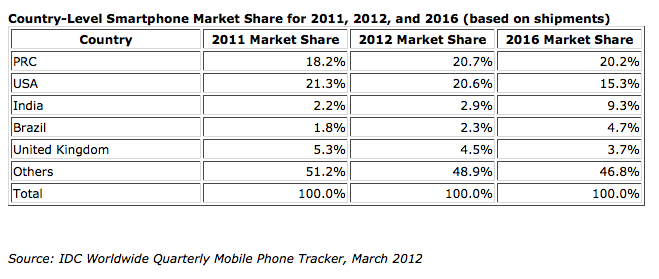
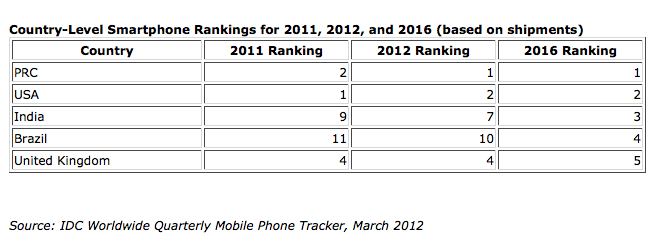
China is already a significant market for companies like Apple, with CEO Tim Cook describing “staggering” and “off the charts” sales of the iPhone in China last quarter. But according to IDC the opportunity is just beginning for Apple and others working in the smartphone world: China is set to become the world’s largest smartphone market this year, overtaking the U.S., which has led in years past.

IDC says this is part of a larger trend of emerging countries getting up to speed with developed nations: by 2016, China will be joined by Brazil and India in the top-five countries in terms of smartphone shipments. Countries like the U.S., U.K. and Japan will continue to see growth, but not at the rate of these other, more populated countries.

The growth of China is something that IDC had already started to track in 2011: China had already overtaken the U.S. in terms of shipments in the last two quarters of that year, it said today.

The shift raises questions about pricing and what we might expect in these devices as they roll out to bigger markets.

IDC notes that so far, in China, it has been the rush of sub-$200 Android devices that have benefited most from the surge in smartphone demand. But it believes that the trend will be for smartphones to cost less than $50.

The big names so far have been domestic handset makers like Huawei, ZTE, and Lenovo, but Samsung and Nokia (which had once led the smartphone market in China before the Android onslaught) are also playing a part with the launch of cheap devices. Nokia’s first Windows Phone handset China — one of its less expensive Lumia devices — is expected to launch by the end of this month.

That drive for domestic handset makers is not only being played out in China. In India, names like Micromax, Spice, Karbonn and Lava — also developing low-cost devices — are trying to set the agenda for what consumers demand and expect out of their smartphones. However, up to now more global brands like HTC and Samsung have been leading the pack.

Brazil, meanwhile, seems to be facing a still-high cost for devices, and it is only this year that average prices have come down to below $300 for a smartphone. Whether Apple chooses to try to create devices to better target users in markets like this one, rather than continue to aim for the high-end consumer, still remains to be seen.

IDC notes that it will not just be about cheap devices, however: it says that carriers will have to step up with innovative data plans, and probable handset subsidies, to get people using smartphones to their full effect.

Some good headway seems to already have been made in that area in some emerging markets:

Some statistics out yesterday from OnDevice Research found that in China, some 38 percent of consumers are only accessing the Internet from their mobile devices. In comparison, countries like the UK registered at 25 percent; while countries with less fixed infrastructure registered with even higher percentages: Nigeria’s figure was 56 percent, and Kenya’s was 51 percent. In effect, that means the opportunity is there not just for device makers, but for carriers and the many companies developing content as well.

Related articles
Enhanced by Zemanta

14.3.12

China’s holy grail: a leading indicator | beyondbrics FT.com

For anyone foolhardy enough to make Chinese economic forecasts, a constant problem is the lack of crystal balls at hand.

The usual arsenal of predictive tools in other countries – yield curves, stock prices, purchasing manager surveys, Conference Board and OECD indices – all exist in China. But all are market-based measures, making them deeply flawed in an economy which is so heavily managed by the government. So what to believe?

Three leading analysts who cover China have in recent weeks revealed their frustrations at the paucity of leading indicators, but also made a few novel suggestions.

Stephen Green and colleagues at Standard Chartered looked at a series of unconventional data points: wheel-loader and excavator sales, steel and cement production, and projects under construction. Their conclusion was that cement output and construction were indeed useful, but didn’t function as leading indicators. That is, they closely track investment activity in real time, but “there is very limited leading information here”.

Jonathan Anderson, who left UBS this month, used one of his last research notes at the bank to savage the idea that purchasing manger indices (PMIs) are even remotely useful in China. Not only did PMI numbers fail to predict the country’s downturn in late 2008 and recovery in early 2009, they were actually late in detecting the economic changes and thus misleading as coincident indicators.

He writes: “Did this show up in the PMI? Hardly. In fact, if you were watching the index you essentially had no idea that any of this was going on.”

What, then, can we rely on if we want to get a feel for where the economy is headed?

Green reaches for an old stand-by: “After following one tantalising clue after another, we are still left with credit growth as the only leading indicator of investment.”

The beauty of looking at credit growth in China is two-fold. The financial system is dominated by bank lending, making credit issuance far and away the most important factor in liquidity conditions and hence also the best predictor of investment activity. What’s more, credit growth is closely managed by the government through a loan quota system, so it does a good job of reflecting Beijing’s policy preferences, not just market sentiment.

Du Jinsong, a property analyst with Credit Suisse, makes a more unusual proposal for a leading indicator: the production of bricks and pre-stressed concrete piling. To be clear, he is only thinking of these as predictors for property construction – they seem to lead new housing starts by about eight months.

But property is the dominant component of Chinese investment activity and the broader economy is led by investment, so getting the real estate market right would be a very good start.

There is only one problem. The leading indicators proposed by Green and Du point in slightly different directions.

Looking at credit growth, Green forecasts a moderate pick-up in investment growth in the second quarter. Looking at brick and piling production, Du says property construction will probably remain flat for the next six months.

Now, it is of course possible that both are right. Investment growth may accelerate, just not in property. But given China’s frustrating track record for would-be oracles, it is also possible that at least one of the two may be more of a red herring than a leading indicator.

Very interesting post about the tools available to economists for predicting economic growth in China.

1.3.12

Meet The Chinese Guy Who Ripped Off Conan O'Brien

Meet The Chinese Guy Who Ripped Off Conan O'Brien

This is Da Peng. He is a Chinese variety show host, and he recently made his American television debut—for ripping off Conan O'Brien.


On a recent episode, Conan O'Brien showed how Da Peng's program, Da Pang Debade, totally copied Conan's opening animation. O'Brien then copied some of the silly antics of the Chinese show in revenge.

Da Peng's program, however, isn't televised. It's an online talk show, which isn't exactly a household name in China. However, it does have its loyal fans, and it does appear on a major Chinese web network. After Conan took the webshow to task, that could change—being called out by a famous American celebrity does mean Da Peng suddenly has more name recognition as this story makes its way through Chinese cyberspace via microblogs and webforums.

In the most recent show, Da Peng removed the intro animation—the one that ripped off Conan. Then he apologized. "At this point I want to the time to say sorry to Mr. Conan on behalf of myself, my show, and our staff," said Da Peng, who then started doing a "sorry dance". He even refers to his own show as "shanzai" or a Chinese imitation.

He's apparently a comedian, so he's trying to be funny. "I hope English majors, translators and American show lovers will help me translate this," Da Peng added. "We will immediately stop using the opening sequence—and will officially apologize again. We'll have to apologize again after apologizing."

Da Peng then went off on tangent (again, he's trying to be funny), saying that the show's name is too hard to pronounce as well as mentioning Jeremy Lin and the U.S. debt.

Online in China, many seem embarrassed by the show's opening and how it copied Conan. "China invented the four great Inventions (gunpowder, paper, paper Printing and the compass)," wrote one individual online. "But that is in the past, and now all we're doing is plagiarizing and copying... Such a tragedy."

Chinese people might feel embarrassed. Though, if anyone "won" in this brouhaha, it's webshow Da Peng. "The guy downstairs selling fruit even recognizes me," he said about his newfound celebrity. "I guess everyone knows about this now.

"My ex-girlfriend sent me a text saying how she regrets dumping me and how she saw me on American television. Now, I'm international." That you are, Da Peng, that you are.

View Da Peng's apology in the link below.

Da Peng Debade [TV Sohu]

Its always interesting to see what elements of western culture go viral in the Middle Kingdom, just usually with their own Chinese flavor.

28.2.12

China is right to open up slowly - FT.com

The next big global financial crisis will emanate from China. That is not a firm prediction. But few countries have avoided crises after financial liberalisation and global integration. Think of the US in the 1930s, Japan and Sweden in the early 1990s, Mexico and South Korea in the later 1990s and the US, UK and much of the eurozone now. Financial crises afflict every kind of country. As Carmen Reinhart of the Peterson Institute for International Economics and Kenneth Rogoff of Harvard have remarked, they are “an equal opportunity menace”. Would China be different? Only if Chinese policymakers retain their caution.

Such caution permeated last week’s report that the People’s Bank of China has recommended accelerated opening up of the Chinese financial system. Given what is at stake, in both China and the world, it is essential to consider the implications. Maybe the world will then do a better job of managing this process than it has done in the past.

More

On this story

On this topic

Martin Wolf

This plan was published by Xinhua, the state news agency, not on the PBoC’s web site. Moreover, it was published under the name of Sheng Songcheng, head of the statistics department, not that of the governor or a deputy governor. This must mean that it is more an exercise in kite-flying than a policy. Nevertheless, this was published with the PBoC’s approval and, quite possibly, with that of people much higher up still.

The article lays out three stages for reform. The first, to occur over the next three years, would clear the path for more Chinese investment abroad as “the shrinkage of western banks and companies has vacated space for Chinese investments” and so presented a “strategic opportunity”. The second phase, in between three and five years, would accelerate foreign lending of the renminbi. In the longer term, over five to 10 years, foreigners could invest in Chinese stocks, bonds and property. Free convertibility of the renminbi would be the “last step”, to be taken at an unspecified time. It would also be combined with restrictions on “speculative” capital flows and short-term foreign borrowing. In sum, full integration would be indefinitely delayed.

What are the implications of this plan? The answer is that it seems sensible. In reaching that view, one has to take into account the benefits and risks of financial “reform and opening” for China and the world.

The arguments for such opening up to the world are closely connected to those for domestic reform. Indeed, the former cannot be undertaken prior to the latter: opening up today’s highly regulated financial system to the world is a recipe for disaster, as Chinese policymakers know. It is for this reason that full convertibility would come in the distant future, as this plan suggests.

Happily, arguments for domestic reform are powerful. Dynamic financial markets are an essential element in any economy that wishes both to sustain growth and to begin rivalling rich countries in productivity, as China surely aspires to do. More immediately, as Nicholas Lardy of the Peterson Institute for International Economics notes in a recent study: “Negative real deposit rates impose a high implicit tax on households, which are large net depositors in the banking system, and lead to excessive investment in residential housing. Negative real lending rates subsidise investment in capital-intensive industries, thus undermining the goal of restructuring the economy in favour of light industries and services.”*

Yet, as Mr Lardy also knows, this distorted financial regime is part of a wider system for taxing savings, promoting investment and repressing consumption, which has led to huge interventions in foreign currency markets and vast accumulations of foreign currency reserves. The deeper case for reform is that this system no longer contributes to a desirable pattern of development. But it has become so deeply entrenched in the economy that reform is politically fraught and economically disruptive. The question is even whether such reform is politically feasible. It is surely likely to be a slow process.

How would the PBoC’s proposed moves towards opening up then fit with such a cautious reform? Presumably, the greater freedom for capital outflows envisaged for the next five years would partly substitute for accumulations of foreign currency reserves. Yet if this went with suggested moves towards higher real interest rates, China’s savings and current account surpluses might explode, worsening the external imbalances.

This point underlines just how big a stake the rest of the world has in the nature of China’s reform and opening up of the financial sector.

China’s gross savings are running at an annual rate of well over $3tn, which is more than 50 per cent larger than the gross savings of the US. Full integration of these vast flows is sure to have huge global effects. China’s financial institutions, already enormous, are also almost certain to become the biggest in the world over the next decade. One need only think back to Japan’s integration in the 1980s and subsequent financial implosion to recognise the possible dangers. We should be pleased, therefore, that China is taking a cautious approach.

The world has a huge interest in a shift of China’s economy towards more balanced growth. It has a parallel interest in the way China manages its domestic reform and opening up of the financial system. A whole range of policies need to be co-ordinated, particularly over financial regulation, monetary policy and exchange rate regimes. If this is done well, today’s high-income countries’ crisis will not be promptly followed by the “China crisis” of the 2020s or 2030s. If it is done badly, even the Chinese might lose control, with devastating results.

The PBoC suggests a timetable of reforms that would fit with China’s and the world’s needs. But if this is to happen, thorough discussion of all the implications must now occur. China’s policies do not matter for the Chinese alone. That is what it means to be a superpower – as the US should note.

* Sustaining China’s Economic Growth After the Global Financial Crisis, Peterson Institute for International Economics, 2012.

via ft.com

Good commentary from Martin Wolf at the Financial Times.

19.1.12

U.S. ambassador: Political situation in China “very, very delicate” | The Cable

The Chinese people are increasingly frustrated with the Chinese Communist Party and the political situation in China is "very, very delicate," U.S. Ambassador to China Gary Locke said on Wednesday.

"I do believe that there is a power of the people, and there is a growing frustration among the people over the operations of government, corruption, lack of transparency, and issues that affect the Chinese people on a daily basis that they feel are being neglected," Locke told NPR's Steve Inskeep during a Wednesday interview, part of a media blitz Locke is conducting during his visit to Washington.

"Do you think that the situation is fundamentally stable in China right now?" Inskeep asked Locke.

"I think, very delicate -- very, very delicate," Locke responded. "But there were calls earlier this year for a Jasmine Revolution and nothing came of it. I think it would take something very significant, internal to China, to cause any type of major upheaval."

Locke said that since he took over the ambassadorship from former GOP presidential candidate Jon Huntsman, he has become aware of public demonstrations large and small throughout China that ordinary people were using to pressure the government to address their grievances. He singled out a recent protest in the southern Chinese city of Wukan over the confiscation of land without reasonable compensation.

"[The people] basically prevented anybody from the outside from coming in and brought the city to a halt and forced the Chinese government communist leaders to send people to address their grievances," Locke said.

The discord inside China is partly a result of the income and wealth disparity between China's growing middle class and the masses of poor, rural residents, Locke said. He also said the Chinese government's human rights record was worsening.

"[I]t's very clear that in the run up to the 2008 Beijing Olympics and since then, there's been a greater intolerance of dissent -- and the human rights record of China has been going in the wrong direction," said Locke.

Asked for comment at today's State Department press briefing, spokeswoman Victoria Nuland backed up Locke's comments on human rights and the rule of law in China.

"[Locke] obviously speaks for the administration in expressing continued concern that we seem to have an increasing trend of crackdowns, forced disappearances, extralegal detentions, arrests and convictions of human rights activists, lawyers, religious leaders, ethnic minorities in China," she said.

But Nuland declined to repeat Locke's assertion that the Chinese government was potentially unstable.

"I think our message to the Chinese government on these issues is the same message that we give around the world when we have human rights concerns, that governments are stronger when they protect the human rights of their people and when they allow for peaceful dissent," she said.

This is a very interesting comment from the US Ambassador to China and with the pending transfer of power to the next generation of Communist Party leadership the country could be poised for its largest political upheaval decades.

15.1.12

China's med-tech market to grow 17% in 2012 | MassDevice.com

January 12, 2012 by MassDevice staff

The Chinese medical device market is slated to grow 17% in 2012, survey says.

MassDevice On Call

MASSDEVICE ON CALL —China's medical device market is set to grow 17% in 2012, according to a Citigroup hospital survey.

Major medical equipment in the Chinese market include medical monitors and life support, diagnostic imaging, in vitro diagnostics and therapeutic systems.

GE Healthcare (NYSE:GE) leads the Chinese medical equipment market, but in orthopedics and drug-eluting stents, Medtronic (NYSE:MDT), Johnson & Johnson (NYSE:JNJ) and Stryker (NYSE:SYK) take the lead, according to the report.

Sign up to get our free newsletters delivered straight to your inbox


Citigroup's survey, which was based on responds from 383 Chinese hospitals across 29 provinces and cities, also named med-tech titans Philips (NYSE:PHG) and Siemens (NYSE:SI) as leaders in China's med-tech market.

Domestic manufacturers such as Mindray Medical (NYSE:MR), Wandong and Aeon have tapped into the market with the sale of market of patient monitors, anesthesia machines and radiography machines.

The 2012 growth will be largely due to bigger budgets and planned infrastructure upgrades from Chinese hospitals, according to analysts.

State lawmakers push Supreme Court to uphold Obamacare
More than 480 state lawmakers plan to file a brief urging the Supreme Court to uphold President Obama's health care reform law, according to TheHill.com. The group includes at least 1 lawmaker from every state, including the 26 states whose attorneys general are suing to overturn the law's individual insurance mandate. Read more

Device detects cancer cells before they become tumors
University of Missouri researchers' photoacoustic device can detect cancer cells before they become tumors, according to a press release. The laser-induced ultrasound system will soon be available to scientists for cancer studies and will be tested in clinical trials for the early diagnosis of metastic melanoma. Read more

Stanmore Implants launches personalized knee replacement system
Stanmore Implants Worldwide launched the first patient-specific modular knee implant system. Stanmore's system combines robotic bone preparation with a patient specific design gathered during CT scans. Read more

Med-tech causes Iowa fire
A fire in Waterloo, Iowa was likely caused by a malfunctioning medical device, according to the WCF Courier. The fire, which caused nearly $20,000 in damages at an assisted living facility, started when unattended medical equipment was left on a resident's bed. Read more

Permalink

US and EU medical technology companies need to start making plans to take their products to China before the country is able to develop its own medical device national champions. Once the country has the capacity to develop everything themselves, the West should expect their products to be largely shutout of what will be the world's largest market one day.

9.11.11

Ai Weiwei’s taxing conundrum | The World | International affairs blog from the FT – FT.com

The Chinese are voting again. Having lost their chance to determine the outcome of Happy Girls, an audience-participation talent show that has mysteriously vanished from next year’s schedules, they are voting instead for Ai Weiwei, the artist and thorn in Beijing’s side.

Mr Ai was recently slapped with a tax bill of $2.4m, a financial summons that followed several months’ imprisonment earlier this year. But Chinese people in their thousands are offering to help the controversial artist pay. The BBC reports that, according to Liu Yanping, a volunteer at the artist’s studio in Beijing, nearly 20,000 people have donated a total of $790,000, and counting.

Most have done so by electronic transfer. Some – presumably technophobes – have simply lobbed money over the wall and into the artist’s compound. A few notes, folded into paper planes, have sailed over the wall too.

Last week, Mr Ai, whose release from prison was conditional on his not talking to the press, told the FT: “When Chinese people have no other way to express themselves, this is the way they feel they can vote to express their dissatisfaction.” That probably constituted talking to the press. In fact, he has done several recent interviews in defiance of the ban.

Whether Mr Ai will have the last laugh is not yet clear. The Global Times, an English-language tabloid owned by the People’s Daily, wrote: “This event has been interpreted by some foreign media as the Chinese people donating to Ai’s cause. The action has also been regarded as a special protest by the artist.” But it cautioned: “Since he’s borrowing from the public…. some experts have pointed out this could be an example of illegal fundraising.”

So China’s most famous artist, known for his humorous, provocative and occasionally puzzling art, may be damned if he pays his taxes and damned if he doesn’t. Now that’s just surreal.

China imposes curbs on buying property

The southern Chinese city of Zhuhai has introduced restrictions on housing purchases in a sign of the government’s resolve to rein in the property market.

The move on Tuesday came even though prices have started to decline across much of the country.

Similar restrictions have been rolled out in other big cities since last year, including limits on the number of units households can buy, curbs on purchases by non-residents and caps on the amount developers can charge for apartments.

But a big drop in sales volumes and recent price falls in leading markets had led many to assume Beijing would start to ease restrictions.

Shares in most leading Hong Kong-listed Chinese property developers rebounded by between 30 and 80 per cent in the fortnight to last Friday on expectations of imminent easing, although most were still down by more than a third since the start of the year.

Shares in listed developers such as Evergrande, Longfor and China Vanke fell on Tuesday in Hong Kong and Shanghai on news of the Zhuhai restrictions and reports in Chinese media that some large developers were offering big discounts on developments.

Many in the sector fear such discounts could trigger a wave of price cuts amid weak demand just as a large number of new apartments is expected to come to market across the country.

Adding to those fears, data from the China Real Estate Index System released on Tuesday showed average residential property prices across 100 leading cities in China fell 0.23 per cent in October from the previous month, the biggest decline so far this year.

Average prices were still up 5.21 per cent on the same month a year earlier, but this was a slower increase than the 6.16 per cent rise in September.

For most Chinese citizens the rapid price rises of the past few years have put apartments in big cities far out of their reach and the government wants to bring prices down gradually to make them more affordable.

But because of the importance of real estate to the wider economy – housing construction is estimated to make up one quarter of investment and 10 per cent of the country’s gross domestic product – Beijing is wary of triggering steep price declines.

On Saturday, Wen Jiabao, the Chinese premier, said Beijing was looking for a “reasonable correction” in prices and would resolutely continue its property tightening strategy while forcing local governments to implement existing housing purchase restrictions.

Zhuhai, an industrial city in Guangdong province, announced on Tuesday that people who had not paid taxes or social insurance in the city for more than a year could not buy apartments there, while local families were limited to buying one home unit each.

It also imposed a cap on home prices of Rmb11,285 per sq metre for the rest of the year. Any developer asking for higher prices would not be given permits to sell their developments.


via ft.com

Chinese property buyers get BMW thrown in

employee polishes the hood ornament logo of a BMW

The sudden downturn in China’s property market is bad news for many global companies, but luxury German carmakers stand to benefit, at least in one city.

In Wenzhou, where house prices have fallen sharply, a real estate developer said that from Wednesday it would throw in the keys to a BMW with each apartment at a new residential complex for the first 150 buyers.

The deal is a sign of the desperation felt by developers in China’s once-booming property market, which has been pounded by government measures aimed at heading off a bubble. The slowdown is a matter of international concern, with Chinese house construction driving demand for commodities and propping up growth in the sputtering global economy.

Chinese developers have been reluctant to cut prices as transactions have slowed this year, but some are finally capitulating after dreadful sales in October. Others, afraid of the stigma of slashing prices, are offering giveaways such as extra garden plots, Louis Vuitton handbags, cruise vacations and now cars.

“Whoever signs a contract and makes the downpayment will be able to drive away in a BMW,” said the sales assistant at Central Mansions, a cluster of brown towers with 868 apartments that have just come on to the Wenzhou market.

“No, it doesn’t mean that sales are bad. It’s just that we’re trying to attract customers,” she said.

Home to legions of entrepreneurs and speculators, Wenzhou’s economy soared when China was flush with cash. But it has been hit harder than most cities by the government’s shift to a much tighter monetary policy to control inflation, as well as the property clampdown.

Wenzhou’s housing sector is now the weakest in the country, with prices falling 1.4 per cent in September month on month. Its smaller firms have suffered from a lack of bank credit, triggering dozens of bankruptcies and prompting the government to

But while Wenzhou is an extreme case of the stress in China’s property market, it is certainly not alone. Housing prices have started to fall nationwide, according to the China Real Estate Index System.

That has been tough to digest for many Chinese who had come to believe that house values could only rise. When several developers in Shanghai cut their asking prices last month, homeowners protested, ransacking showrooms and demanding refunds.

Fearing similar fallout, many developers are trying to entice buyers with special deals instead of discounts. The BMWs in Wenzhou cost Rmb300,000 locally, equivalent to about 10 per cent of the price for an apartment, the sales assistant said.

Xiaoyunli No. 8, a development in Beijing that has sent workers to leaflet cars at busy intersections, said there would be no discount and no car for buyers.

“But you’ll get a deal and it will be no problem for it to amount to the tens of thousands. It will be like giving you a car,” the receptionist said.

via ft.com

11.9.11

Qualcomm and Life Care Networks partner to battle cardiovascular disease using mobile phones || via @imedicalapps

Qualcomm and Life Care Networks have partnered to launch an initiative called the Wireless Heart Health project to aid in the prevention and treatment of health conditions such as cardiovascular disease in underserved communities in China. According to the World Health Organization (WHO), chronic diseases, such as cardiovascular disease, are a major problem in China with close to 3 million deaths a year.

Because of the prevalence of mobile phones in China, an idea formed that would allow critical medical care to be given in areas of China that would otherwise never have access.

“With a grant from Wireless Reach, the Wireless Heart Health project is deploying a 3G-enabled cardiovascular screening and monitoring system, developed by Life Care Networks, for resource-scarce community health clinics in Shandong, Anhui and Sichuan provinces, as well as the Chongqing municipality.  Community Health Association of China is assisting in clinic selection, project implementation and impact analysis.”

The smartphones contain added sensors (such as ECG) that aid in diagnostics.

“The new 3G system includes smartphones with built-in electrocardiogram (ECG) sensors; web-based, electronic medical record software; and 3G wireless workstations located within the clinics.  Each workstation includes a computer terminal with Internet access, providing health care workers with instant access to electronic patient records, including ECG data.  The project also includes training sessions for all participating community health center clinicians.”

The Wireless Heart Health project allows smartphones to automatically send critical patient data to a cardiac specialist at a call center.  This call center contains doctors that provide feedback to patients and clinic staff over the phone or through text messages. Physicians can remotely provide service for simpler cases or suggest a specialist follow-up in-person. Finally, Qualcomm expects to make some of the ECG-enabled smartphones available for patients to rent and take home.

For further reading, please view Yahoo Finance.


Qualcomm takes their wireless health technology and vision to China for wireless ECG experiment called Wireless Heart Health in western China.

4.4.11

Ai Weiwei China's Best Known Artist Arrested in Beijing

Media_httprwwreadwrit_ihkjk

Ai Weiwei, designer of the "Bird's Nest" Beijing's 2008 Olympic stadium, was detained today in Beijing as he attempted to board a flight to Hong Kong. His Beijing studio was also raided and his staff and family taken into custody. Ai had apparently been making plans to relocate his studio to Germany and has long experienced government pressure to silence his creative expression. I think this is a huge mistake by the Chinese government. If they want to avoid the fate of the Middle Eastern and North African governments that have seen their people rise up against autocracy they would be wise to not so blatantly harass the country's most revered artist.