The title of this weblog is borrowed from a book that has greatly impacted my approach to studying and observing China, and has led me to conclude that the future of America is becoming more deeply embedded in the future of Asia every day. That book was NY Times op-ed columnist Nicholas Kristof's memoir about his experiences while working as NYT bureau chief in Beijing. According to Kristof, Napolean once said that "When China wakes, it will shake the world." Can you feel it?
The Chinese government has just released details of its planned space flights for 2008, leaving few to doubt the true emergence of a third player in the geo-political battle for control over near-Earth orbit. The boldest mission will be the third manned space flight launched by China and will feature the first spacewalk by a Chinese astronaut.
The much anticipated mission will be Shenzhou 7, and is slated for October. This will be a glorious time in Chinese history, provided the government can manage the seemingly impossible challenge of the Summer Olympics, and this human spacewalk will be the cherry on the proverbial sundae for the CCP leadership.
For the last decade, China has been meticulously grooming its capital city, Beijing, for the curious eyes of eager Western consumers and potential business opportunities offered by the 2008 Summer Olympics. The Chinese Communist Party (CCP) has made grand promises of wealth and universal well-being to its vast citizenry, all of which hinge upon the near flawless production of the most anticipated event in the history of the Middle Kingdom.
Can the government contain the political powder-keg over which it rules? Will the world accept a Chinese superpower under Communist rule? History is hanging in the balance and nobody (least of all the CCP) knows what to expect in 2008, but I certainly look forward to sharing my thoughts on how America, and the West generally, should respond to the emergence of a more powerful and confident Chinese people.
I also welcome the submissions of papers, presentations, essays or videos anyone would like to contribute. Below I have embedded a great presentation compiled by a dear friend of mine, Victor Lang, who is a native of Hong Kong. Victor and I share many similar interests, such as China-Africa relations, international perception of Chinese politics, and domestic censorship by the CCP and corporations it intimidates to comply with their ridiculous media policies.
Happy New Year to all China Wakes readers and a toast to what will hopefully be remembered as the greatest year in the history of mankind's largest and oldest civilization.
I used to think that I was a moral absolutist, and I would regularly dismiss my friends when they would attempt to justify something I considered "inhumane" as the position of a moral relativist, who sees fundamental differences in the way one human-being values the life of another based on cultural differences. It did not take long after I became interested in China for me to abandon my preconceived notions, which were likely the by-product of nearly two decades attending Catholic schools, and an attempt to more fully understand why it is that human life is not valued equally by all, or more importantly, why it cannot be such.
I always knew China was huge, but it never registered with me exactly how huge until I began studying the Chinese Communist Revolution and the major social movements subsequently led by Mao Zedong in an effort to "purge" his country of right-wing dissidents that may eventually pose a threat to the Communist Party's universal authority. The two largest massacres of human life in the 20th century were at the hands of Communist Chinese cadre, some of whom reverted to truly barbaric practices like cannibalism at the instigation of local and national party leaders. Literally tens-of-millions of Chinese citizens were murdered piecemeal during the "Long March" and "Cultural Revolution", yet still the country's population multiplied exponentially during the baby boom era. Growth was so amazing and untenable that the Party was forced to institute drastic population control laws, which we know as the "One Child Policy". Every living Chinese citizen has spent most, if not all, of their life in a fractured society built according to a strict social plan that harshly punished even the slightest deviation.
It is through the lens of this grossly incomplete history of 20th century Chinese growth and development that the West has chosen to judge the ethical standards of a civilization that makes up one-fifth of the worlds population, and has been wholly isolated from the world community until the last thirty years because of internal strife and political instability. I would never pretend that these are ideal circumstances from a Western perspective, or that these tragedies were unavoidable, but I believe it is essential that we not hold the common Chinese citizen responsible for the sins of paranoid men now but a memory. We must recognize that the Chinese people are aware of the differences between our cultures, and are ashamed of the history that we consider to be barbaric.
I have friends from China who comment to me often on how compassionate American culture is compared to their own. They can hardly believe it when they turn on the news to see 30 minutes of coverage on the investigation into the disappearance of one person, and they comment often on the propensity of Chinese media to completely ignore incidents such as floods, and poisonings of water reserves that literally kill whole towns of people in rural provinces.
I had a very difficult time trying to understand what the fundamental difference between the two civilizations that creates this culture of apathy on matters that we in America mourn daily as a nation. The value of each individual life in the US is truly held sacred by the media, which is largely due to the fact that these stories are the driving force behind stronger ratings because of the emotional response they elicit from viewers. Chinese media are much more interested in telling stories about great economic growth and massive engineering projects instead of the more emotionally charged stories, both because they cast the government in the most favorable light possible, and because this is what draws the attention and fascination of the average Chinese citizen.
You may be asking yourself, what is the underlying cause of this cultural divide? After much thought and reflection, I have reached two conclusions. First, Chinese society is essentially atheist, the antithesis of traditional American society, which has largely evolved from small communities built around the local church. Those who are deeply religious in China are absolutely in the minority, and their activities are viewed with great suspicion by the political classes of society because of the role religion has played historically in revolutionary political movements around the world. Secondly, the collective pride of Chinese society and the feelings of inferiority and lack of appreciation they have received from the more "developed" societies of the world, have created within the greater society a more focused and goal oriented vision of where their country is going and how progress toward that end earns them the respect they deserve around the world.
Though this narrow-minded, and less compassionate view on the world is largely the result of government suppression of dissent and censorship of news that serves as a distraction from Party plan, we should not be so jingoistic as to assume that we have any right or reason to pass judgment on a society that we should not even claim to understand. 1.5 billion human-beings is a staggering thought, and such circumstances are truly unprecedented in the history of nation-states.
To judge the undoubtedly complex and morally taxing decisions of the Communist Party Officials according to moral absolutes that we have concluded to be non-negotiable measures of social progress and worthiness of full diplomatic and economic recognition, is to me one of the most ignorant distortions of 21st century realities and further evidence of the poisonous opportunistic political culture that currently reigns in Washington. We cannot presume to understand the responsibility facing the Chinese Communist Party, and it is highly ignorant and dangerously presumptuous to arbitrarily decide that we can better judge the method of governance that is best for a country that in no way, demographically or ethically, resembles our own.
Continuing the movement to boycott the Beijing Olympics next summer is one of the most disturbing examples of political opportunism, worse than most because it is based on an assumption of clearly non-existent moral absolutisms. The only way to effect the social ethos of Chinese, or any other civilization, is to earn both their trust and respect. The more American politicians deride the "values" of our competitors, the greater the chances that mutual prosperity will fall victim to cultural resentment and unhealthy competition between the two greatest and most dynamic societies the world has ever known.
This was written in a stream of consciousness, so it may be fractured and incoherent. I would appreciate any comments that you may have so I can revise and clarify my thought. Thanks.
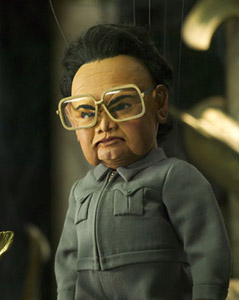
As I am sitting here watching the pundits tear each other to pieces on the FoxNews show Forbes on Fox, I am struck by what should have been a rather obvious point. The Beijing Olympics (a.k.a. China's great coming show) has the potential to make or break the emerging superpower in the eyes of the apprehensive western world. In Nicholas Kristof's brilliant book, and the inspiration for the name of my other blog, China Wakes he descibes a rather gruesome story that was recounted to him by a local party official in Beijing about the extent to which the government was willing to go to ensure the cities selection as the host of the '08 games. In touching detail and sincerity he tells the story of a young man who suffered from downs syndrome and suffered and sudden fits of seizure. This young man's parents' home was located along the route planned for the Olympic Committee's tour of Beijing and local police began to worry that he may unwittingly embarrass the city and cause the country their opportunity at securing the games. The government's solution was to kidnap him from his crying mother's arms and send him to a rural prison camp, where he was subsequently beaten to death without any recourse taken by the local government to compensate the family or bring to justice the guilty party. If the government is that paranoid about the impact a single mentally disabled Chinese may have on the image of their country in the eyes of the world, I find little reason to believe they are going find any benefit in allowing the North Korean leader to stay in power for very much longer. I have yet to see any indication that the US plans to change their policy, which is the obvious goal of the recent brazen tactics of Kim Jong-Il's regime, an thus it seems likely they will continue to flex their muscle and further pressure the Chinese to withdraw their support. Either way, a peaceful solution is quickly fading on the horizon.

![Reblog this post [with Zemanta]](https://lh3.googleusercontent.com/blogger_img_proxy/AEn0k_u-RuDPuPXsfBvcqeEpf6R8C0vHIXB2VXDXFnV4plVNBts0kujAA1P7oGHiN_Vbq2VOEKk6FB-cXwF1Fir5r7u6eg1SctmrcigResrF3ZMKPWqDemh0gsOgGsmvCI7aXdih5mzMb6Ep_fwmnzsSvKZh=s0-d)


![Reblog this post [with Zemanta]](https://lh3.googleusercontent.com/blogger_img_proxy/AEn0k_uDVrjem-Uf-fhN6Tbj4PMKcBiQPSA9PHmKLH0H7ad4CLHguC4D_Q8-mIwTNcl5qxQRL6PU9Md61X7wum09AKE6ZK2AQlDTM15B3w7HUrijoq6Vrf2jG2PQoVFZheHwAlalBaKMMeiU-r-8V6J02wgO=s0-d)


![Reblog this post [with Zemanta]](https://lh3.googleusercontent.com/blogger_img_proxy/AEn0k_sanY3un6628lfcFHTs0_EAh5DtFLMaAuZsApqc_sT44lN0DgxlNrkT_IcSkIsNKkzoZaFTNKWVAgCx4vB22sJPbLDRtGeQZeQI9gHdN7recIRiAYyIClKA6q6KqCLL5JwzHQ1XqRTZFbtS1W9Vmsan=s0-d)